

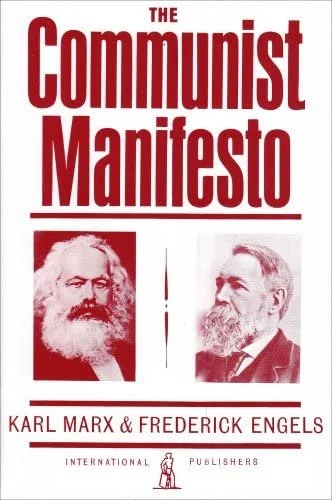
Manifesto of the Communist Party
The “Manifesto of the Communist Party” was written by Marx and Engels as the Communist League’s programme on the instruction of its Second Congress (London, November 29-December 8, 1847), which signified a victory for the followers of a new proletarian line during the discussion of the programme questions. When Congress was still in preparation, Marx and Engels arrived at the conclusion that the final programme document should be in the form of a Party manifesto. The catechism form usual for the secret societies of the time and retained in the “Draft of a Communist Confession of Faith” and “Principles of Communism,” was not suitable for a full and substantial exposition of the new revolutionary world outlook, for a comprehensive formulation of the proletarian movement’s aims and tasks.
A Critique of the German Ideology
Once upon a time a valiant fellow had the idea that men were drowned in water only because they were possessed with the idea of gravity. If they were to knock this notion out of their heads, say by stating it to be a superstition, a religious concept, they would be sublimely proof against any danger from water. His whole life long he fought against the illusion of gravity, of whose harmful results all statistic brought him new and manifold evidence. This valiant fellow was the type of the new revolutionary philosophers in Germany.
Condition of the Working Class in England
The state of things described in this book belongs to-day, in many respects, to the past, as far as England is concerned. Though not expressly stated in our recognised treatises, it is still a law of modern Political Economy that the larger the scale on which capitalistic production is carried on, the less can it support the petty devices of swindling and pilfering which characterise its early stages.

The Housing Question
On June 26 1872, Engels contributed the first of a series of articles to the Volksstaat, entitled “The Housing Question.” The last appeared on February 22 1873. Engels’ central point was that the revolutionary class policy of the proletariat cannot be replaced by a policy of reforms, because "it is not that the solution of the housing question simultaneously solves the social question, but that only by the solution of the social question, that is, by the abolition of the capitalist mode of production, is the solution of the housing question made possible.